
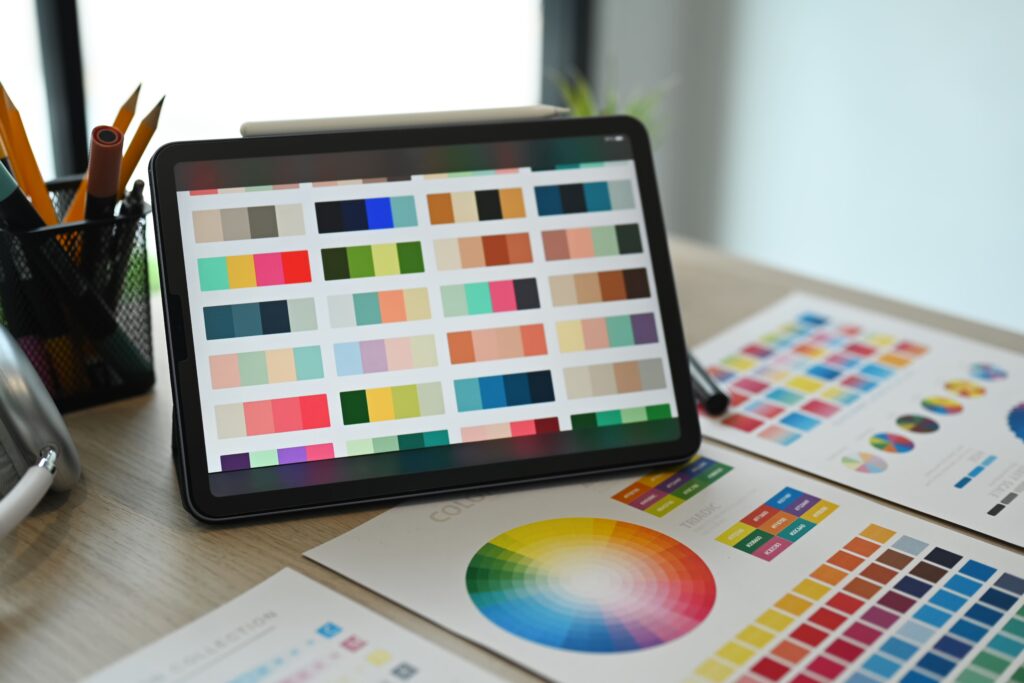
In this comprehensive guide, we’ll take you through the journey of selecting the ideal colors for your restaurant or café brand identity, explained in detail.
In this comprehensive guide, we will take you through a strategic journey to select the ideal brand identity colors for your restaurant or café. Did you know that most purchase decisions are made in the subconscious mind and are directly influenced by colors?
When a customer walks into your venue, the very first thing that grabs their attention is not the menu, but the surrounding colors. Consequently, colors are not merely visual decorations; rather, they are a silent language. They subconsciously speak to your customers about the quality of your services, your pricing level, and even the “taste” of your food before they take a single bite!
Choosing your brand identity colors must rely on science, not just personal taste. Here is exactly how the human brain translates colors:
🔴 Red: Energy and Appetite
Best for: Fast-food restaurants, burger joints, and vibrant venues.
The Psychological Message: Besides grabbing attention instantly, red sends a clear message: “Here, you will find high energy, fast service, and bold flavors.”
🟤 Brown: Warmth and Authenticity
Best for: Specialty cafés and classic family-style restaurants.
The Psychological Message: Conversely, brown reflects a calming message that says: “An authentic, cozy place that feels just like home.”
🟢 Green: Health and Nature
Best for: Healthy food spots, fresh juice bars, and vegan cafés.
The Psychological Message: The brain immediately links this color to the phrase: “Fresh, healthy, and nature-inspired ingredients.”
🔵 Blue: Trust and Cleanliness (A Risky Food Color!)
Best for: Seafood restaurants exclusively, or premium water brands.
The Psychological Message: While blue generally suppresses appetite, it simultaneously sends a powerful message: “We provide top-tier quality, absolute cleanliness, and complete reliability.”
Before you open a color palette, ask yourself: “Who am I as a brand?” Based on your answer, your optimal brand identity colors will emerge:
The Trendy Café: Features a young and innovative personality. Therefore, metallic shades combined with bold accents (like neon yellow or hot pink) suit it perfectly.
The Family Restaurant: Characterized by a warm and welcoming vibe. Consequently, earthy tones such as beige, dark brown, and warm orange are the ultimate choices.
Luxury Dining: Offers an exclusive, premium experience. From this perspective, nothing beats royal black, gold, or deep purple to reflect pure elegance.
Your choices must precisely match your audience’s visual expectations. For instance:
For Families: They prefer warm, eye-soothing colors. Thus, you must avoid extremely harsh or overly bright tones that might cause visual fatigue.
For Young Adults & Students: They are highly attracted to bold, modern colors that look great on social media (Instagrammable). Therefore, strictly avoid traditional or dull color schemes.
Analyzing competitors is a crucial step to ensure your brand identity colors truly stand out. Collect the visual identities of your key local competitors and identify the dominant market colors. Ultimately, the goal is not to imitate, but to select colors that help you stand out without being completely disconnected from your industry’s nature. (Hint: You don’t have to use green just because your healthy-food competitor did!)
Do not rush into printing your signboards! Use these free testing methods first:
Social Media: Share different versions of your logo and monitor the audience’s reactions.
A/B Testing: Launch small-budget ads with two different color palettes to see which one drives more clicks.
💡 Pro Tip from Basirah: Create 3 mock-up designs using the exact same layout but with different colors. Show them to at least 10 people from your actual target audience to gather real-world impressions.
❌ Mistake: Using too many colors randomly, causing visual clutter. ✅ Solution: Stick strictly to a maximum of 3–4 colors (Primary, secondary, and one or two accent colors).
❌ Mistake: Ignoring how interior lighting affects colors. ✅ Solution: Always test your color swatches under the actual physical lighting of your space before final approval.
❌ Mistake: Forgetting the cultural context of colors. ✅ Solution: Always study the local cultural connotations of colors; a color that symbolizes joy in one culture might mean something entirely different in another.
In summary, selecting brand identity colors is never just an aesthetic decision; it is a genuine investment in your customers’ memory and emotions. By understanding color psychology, defining your brand personality, and studying your audience, you will build an unforgettable visual image.
At Basirah, we don’t just design logos; we engineer comprehensive digital and visual assets. Whether you have an existing visual identity that needs an upgrade or you are starting from scratch, claim your free preliminary quote today. We will craft a creative roadmap tailored strictly to your budget that maximizes your impact in the market.